Your Guide to Creating a Personalized AI Companion This Year
Compare top frameworks to build your open source AI girlfriend. This guide reviews Rasa, Mycroft, and custom stacks to help you create a personalized AI companion.


You can create a personalized AI companion. Beginners should use an open-source framework like Mycroft. Advanced users can build a custom open-source stack. This guide compares open-source tools for your open source ai girlfriend or a custom AI chatbot. The AI personalization market is huge, showing demand for this AI technology. Understanding these open-source AI terms is key for your open-source AI project. The best open-source models make a smart AI chatbot. These models are the AI's brain. Open-source ai chatbots rely on these powerful open-source models. An open-source AI needs the right models.
- Large Language Model (LLM): The AI brain that understands and generates text. Different models have different skills.
- Text-to-Speech (TTS): The AI voice that converts text into spoken words for your open-source chatbot.
Why Choose an Open-Source Framework?
Choosing an open-source framework gives you the tools to build a truly unique AI companion. An open-source approach provides many advantages over closed systems. This path is great for developers and hobbyists who want control over their AI chatbot project. The global open-source community drives rapid innovation.
The Power of Customization
Open-source AI frameworks offer incredible customizability. You are not limited to pre-set options. You can modify the code directly to create a specific personality or add unique skills to your AI chatbot. This high customizability is a key benefit.
For example, tools like LangChain allow you to build a private AI agent from scratch. You can fine-tune your chatbot to have a company's full knowledge base or an AI friend with a custom personality.
The flexibility of open-source AI is unmatched.
- You can avoid being locked into one company's system.
- You can experiment freely and share your modifications with the community.
- You can scale your project efficiently for different needs.
Ensuring Privacy and Control
Privacy is a major reason to choose an open-source AI solution. You can run your AI companion on your own hardware. This means your conversations can remain completely private. An open-source chatbot offers the potential for increased privacy because your data never has to leave your server. However, this control also means you are responsible for securing your data. Proper setup is essential to protect your information. The open-source community often provides support for securing your AI.
Learning from Platforms like Rubii
Platforms like Rubii show the creative potential of personalized AI. Rubii allows users to create AI companions within rich, character-driven stories. It fosters a vibrant community where people share their creations. This highlights the power of user engagement and interaction. Rubii empowers users with features like:
- Adjustable AI dialogue styles.
- Text-to-character generation.
- Interactive storytelling with AI partners.
Studying platforms like Rubii can inspire your own open-source project. It shows how a strong community and powerful tools can create amazing AI experiences. The open-source community provides a similar space for collaboration and shared learning.
Building Your Open Source AI Girlfriend
Choosing the right framework is the most important step in creating your open source ai girlfriend. The best tool depends on your technical skill and project goals. Some open-source chatbot platforms are great for text, while others excel at voice. Let's explore three popular open-source paths to build your ideal AI companion.
Rasa for Advanced Dialogue
Rasa is a powerful open-source framework for building sophisticated open-source ai chatbots. It is designed for developers who want deep control over dialogue and context. This platform is not for absolute beginners. It requires knowledge of Python and Natural Language Processing (NLP).
Best For: Developers building complex, context-aware chatbots with custom business logic.
The key features of Rasa give you precise control over your chatbot. Its modular design has two main parts. Rasa NLU handles understanding user input, and Rasa Core manages the conversation flow. This separation allows for powerful customization. The key features of the framework are extensive.
- Advanced Dialogue Management: Rasa uses a system called CALM (Conversational AI with Language Models). This helps the AI agent understand context beyond simple commands.
- Natural Language Understanding (NLU): This core component enables your chatbot to interpret user messages accurately. You can fine-tune the NLU models for your specific domain.
- Scalable Integrations: Rasa connects easily with many services. You can link your chatbot to platforms like WhatsApp or assistants like Amazon Alexa.
- Total Customization: As an open-source tool, Rasa gives you full access to its code. You can create custom components and train models with your own data for a unique AI experience.
Note: Rasa offers built-in security features. It helps protect against common issues like prompt injection. You can also run it on your own server for complete data privacy. The key features are designed for robust performance.
Rasa provides unparalleled flexibility. This makes it one of the top open-source chatbot platforms for creating a highly personalized AI. The key features support this flexibility.
Mycroft for Voice-First Companions
Mycroft is an open-source voice assistant. It is an excellent choice for beginners or anyone wanting a voice-first AI companion. Mycroft is easier to set up than Rasa. It focuses on spoken interaction. You can build your own smart speaker.
Best For: Beginners and hobbyists who want a customizable, private voice assistant.
Mycroft's key features are built around a modular architecture. This design makes it easy to swap components. For example, you can change the text-to-speech (TTS) voice. The key features work together to create a seamless voice experience. The open-source nature of Mycroft is a major advantage. Its key features include:
- Wake Word Detection: This lets the AI listen for a specific phrase, like "Hey Mycroft," before it starts processing your command.
- Speech-to-Text (STT): It converts your spoken words into text that the AI can understand.
- Intent Parsing: Mycroft figures out what you want to do from the text. This is how it understands commands.
- Skill Development API: This is the most exciting part. You can create new abilities, or "skills," for your AI. You can teach it to control smart home devices or tell you specific jokes.
Mycroft is a fantastic open-source project for learning about AI. It provides a hands-on way to build a functional and personal AI assistant. The key features are well-documented. This open-source tool is perfect for a home-based AI project.
Custom Stacks for Ultimate Control
For the ultimate level of personalization, you can build your AI from scratch. A custom stack uses different open-source libraries combined in a unique way. This path offers total freedom but requires strong programming skills, especially in Python. You can create a truly unique open source ai girlfriend with this method.
Best For: Advanced developers and AI experts who want complete control over every aspect of their AI companion.
Using a framework like LangChain with Python is a popular approach. This method lets you connect powerful LLMs to other sources of data and logic. The key features of a custom stack are the components you choose. A typical stack includes:
- Models (LLM Wrappers): This is the brain of your AI. You can use various open-source models and switch between them. These models provide the core intelligence.
- Prompts: You create dynamic templates to guide the AI's personality and responses. This is how you define your chatbot's character.
- Chains: Chains link different AI actions together. For example, a chain could take a user question, find an answer from a document, and then format a friendly response.
- Embeddings and Vector Stores: These are crucial for long-term memory. They turn text into numbers (vectors) and store them. This allows your AI to remember past conversations and custom knowledge.
- Agents: An agent acts as the orchestrator. It uses the other components to perform tasks and make decisions, giving your AI a sense of autonomy.
Building a custom stack for your open source ai girlfriend is a challenging but rewarding project. It provides the highest level of control over your AI's personality, memory, and abilities. This open-source approach is perfect for developers who want to push the boundaries of what open-source ai chatbots can do. The key features you build are entirely up to you.
Feature Comparison Table
Choosing the right open-source tools is vital for your project. This comparison will help you understand the key features of each approach. A good open-source ai project starts with the right foundation.
Primary Use Case
Each framework serves a different primary purpose for your ai companion. Your choice depends on whether you want a text-based chatbot or a voice-first assistant.
- Rasa: Best for building a complex, text-based open-source chatbot. Its key features focus on advanced dialogue.
- Mycroft: Ideal for creating a voice-controlled open-source assistant, like a custom smart speaker.
- Custom Stack: Perfect for any use case. It offers total flexibility to build a unique ai chatbot from the ground up.
Some projects even combine frameworks to leverage their strengths. This shows the power of open-source collaboration.
The CA, which used the Rasa framework, was accessible via an Android application on a smartphone based on the Mycroft companion app.
Required Technical Skill
The technical skill needed varies greatly between these open-source options. Your programming experience will guide your choice.
- Rasa: Requires intermediate skills, including Python and an understanding of how ai models work.
- Mycroft: Beginner-friendly. Basic scripting knowledge is helpful but not essential for getting started.
- Custom Stack: For experts only. This path demands strong Python skills and deep knowledge of ai architecture and models.
Personality Customization
Customizing your ai companion's personality is a key part of the fun. Each open-source platform handles this differently. The key features of each tool determine how you shape your ai.
- Rasa: You define the chatbot personality through training data and conversation flows.
- Mycroft: Personality comes from custom "skills" you can write or download from the community.
- Custom Stack: Offers unlimited customization. You control the personality through detailed prompt engineering and fine-tuning ai models.
Memory Management
An ai companion needs to remember past conversations. The key features for memory are crucial for a believable chatbot experience.
- Rasa: Has robust built-in tools to manage conversation context and short-term memory.
- Mycroft: Provides basic memory within a single conversation session.
- Custom Stack: You can implement powerful long-term memory using vector stores. This allows your ai to remember details from weeks or months ago. The open-source community provides many examples.
Community Support
A strong community is one of the best key features of any open-source project. This support is invaluable when you need help.
All three options have an active open-source community. You can find help through forums, documentation, and shared code. The Rasa community is focused on chatbot developers. The Mycroft community is great for hardware hobbyists. The general open-source ai community supports custom stacks with a huge number of libraries and models. This community support makes building your own ai possible.
Your Quick-Start Guide

Ready to build your own AI companion? This guide provides four simple steps to start your open-source project. Following these steps will help you create a personalized AI experience.
Step 1: Select Your Framework
First, choose your foundation. Your choice depends on your goals and skills.
- Mycroft: Best for a voice-first open-source assistant.
- Rasa: Ideal for a complex, text-based open-source chatbot.
- Custom Stack: For experts wanting total control over their AI.
Step 2: Check Your Prerequisites
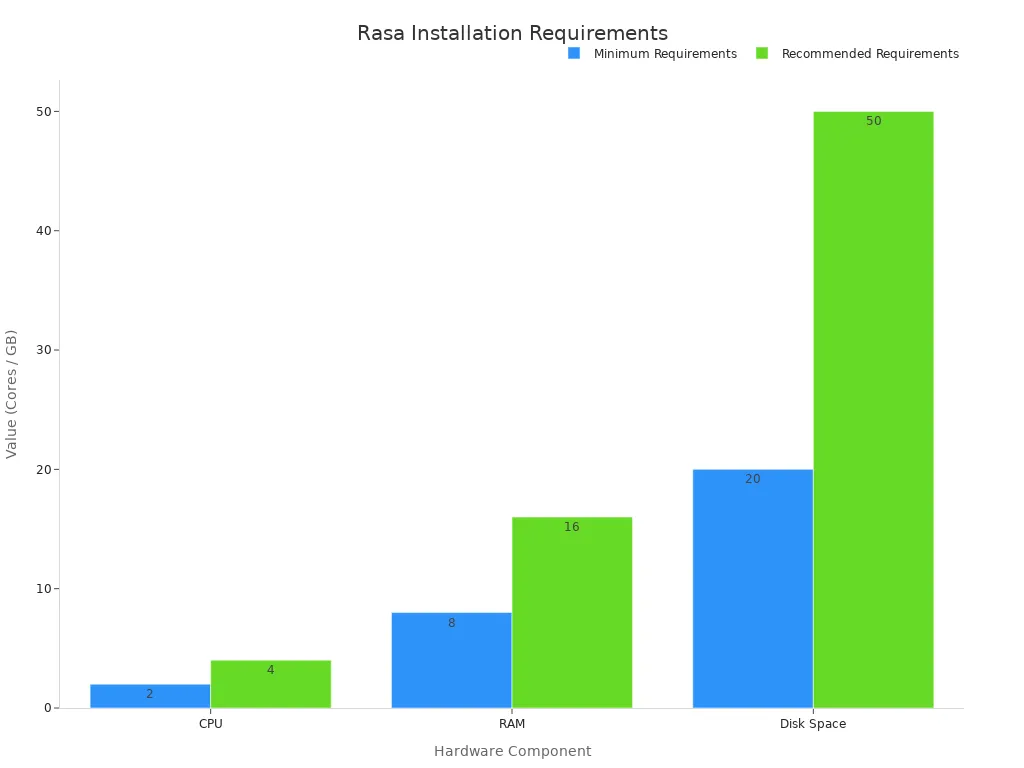
Next, check your hardware. Your framework choice determines what you need. A Rasa open-source project, for example, has specific requirements.
| Component | Minimum Requirements | Recommended Requirements |
|---|---|---|
| CPU | Dual Core | Quad Core |
| RAM | 8 GB | 16 GB |
| Disk Space | 20 GB Free | 50 GB Free |
An open-source Mycroft setup often runs on a Raspberry Pi 3B or newer. A custom stack's needs will vary based on the local ai models you select.
Step 3: Choose the Right LLM
The LLM is your AI's brain. For a companion chatbot, always choose "chat-tuned" models. These models are trained on dialogue, making them better at conversation than general-purpose models.
The size of your local ai models also matters.
Model size directly impacts performance. Smaller local ai models (like 7B) are faster and run on normal computers. Larger local ai models (like 70B) are smarter but need powerful hardware.
Many open-source local ai models are available, so you can find the right balance. Choosing the right local ai models is key for your open-source ai chatbots. There are many open-source local ai models to power your AI. These local ai models are the core of your open-source AI.
Step 4: Define Your AI's Persona
Finally, give your AI a personality. A persona makes your chatbot feel unique. You can define its role, background, and communication style. You create this personality using system prompts. This tells the AI how to act. For example, you can instruct your chatbot to be a helpful and curious friend. This step transforms your open-source project from a simple program into one of the best open-source ai chatbots. A well-defined persona is what makes your open-source AI truly special.
Your journey to create a personalized AI companion starts now. For an accessible voice assistant, the open-source Mycroft framework is an excellent choice. Developers seeking deep personalization for their open source ai girlfriend should use a custom open-source stack with LangChain. The best open-source framework depends on your technical skill and creative vision. This open-source approach allows for diverse projects, from a privacy-focused chatbot to advanced business tools. The right open-source models are key. Start your project and engage with the vibrant open-source community. This community offers support for your chatbot and its models. The open-source community helps you select the best models. The open-source community also provides guidance on different models.
FAQ
Can I create an AI companion without coding?
Yes. An open-source framework like Mycroft is great for beginners. It has a supportive community and many pre-built skills. You can assemble a voice assistant with minimal coding knowledge. This open-source project is very accessible.
Where can I find open-source AI models?
You can find many open-source models on platforms like Hugging Face. This website is a huge library for different AI models. You can search for specific models that fit your project's needs. The community shares many powerful models there.
Is using open-source AI really free?
The software is free. However, you might have costs. Running powerful models requires good hardware. You may need to pay for cloud services if you do not use your own computer. This open-source path offers flexibility in spending.
How do I update my AI's models?
Updating your AI's models depends on your setup.
- Frameworks often have guides for updating models.
- A custom open-source stack requires you to manually download new models.
- The open-source community provides support for this process. Keeping your models current improves performance.
See Also
Your Ultimate 2025 Guide: Crafting a Free AI Girlfriend Online
Crafting Your Personalized AI Boyfriend Using Simple Online Tools
Effortless Personalization: Chatting with Your AI Boyfriend Made Simple
Discovering the Top AI Girlfriend Generators Available in 2025
Building Your First AI Girlfriend Video: A Beginner's Tutorial