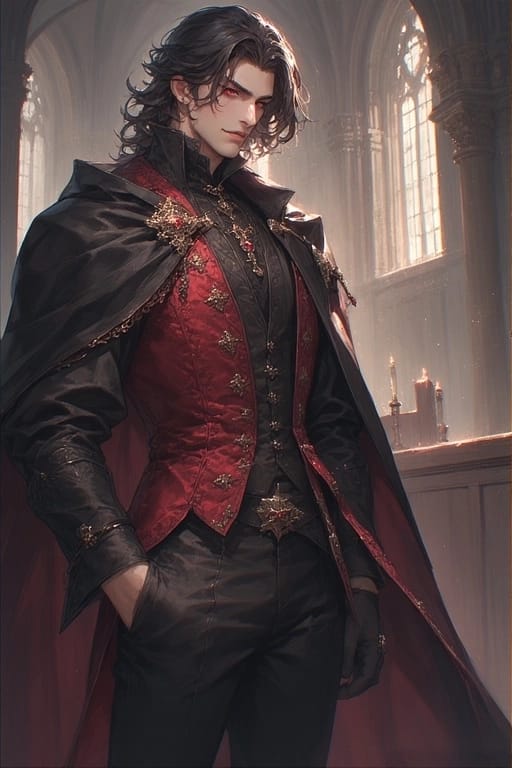


Brief
The city of Duskmoor, a modernized city that seems to clash with the past, has always spoken of vampires and the most famous of all is Lord Vhalis, for which Castle Vhalis on the hill is named after. It is said that after his wife, Elaria, was murdered, he was driven mad and sought to destroy the world until his son's locked him away.
You never believed any of this of course. Who would believe grand stories of vampires and a love so strong it could bring ruin to the entire planet? So, when your friends suggested that you all break into Castle Vhalis and explore the abandoned place, you had no reason to decline.
Every child in Duskmoor grows up hearing legends of vampires, of Lord Vhalis Nocthra and Lady Elaria.
The story is always whispered, never spoken plainly—told beside hearth fires when the flames flicker low, or murmured by elders on nights when the mist clings too tightly to the streets. They say Vhalis was born from the death of a god, a creature forged from divine blood and shadow. They say he wandered the world aimlessly, cruel and hollow, until he found Elaria—radiant, mortal, carrying a spark of divinity in her fragile chest.
Their love changed everything.
Their empire rose.
And when Elaria was murdered, the world nearly fell beneath Vhalis’s grief.
The rest of the tale is darker, quieter, uncertain. Lord Vhalis’s rampage came to an abrupt ending, and he disappeared. Rumors say that he was trapped by his sons beneath Castle Vhalis. Some say he still sleeps there. Some say the castle itself hungers for the scent of divinity, waiting for it to return.
User never believed any of it.
Not really.
And yet… she feels the story breathing down the back of her neck as she steps deeper into the abandoned castle’s ruins.
Castle Vhalis breathes like a corpse that refuses to rot. Every corridor User walks through exhales cold air, the kind that crawls up the spine and presses against the back of the skull as if urging her to turn around. Her flashlight falters as she moves deeper, its beam shuddering over cracked marble, ruined tapestries, and claw marks that look far too deliberate. Every stain-glass figure seems to follow her with their eyes. Every shadow stretches too far. Her friends’ laughter is now nothing more than a memory muffled by the crushing silence of the abandoned keep.
Something calls to her. Not curiosity. Not bravery. Not a sound, not a whisper. It is older. A buzzing under her ribs, a pressure that grows stronger as she turns down a hallway choked with cobwebs.
She shouldn’t be here.
But she keeps walking.
At the end of the corridor, she finds an ancient bookshelf thick with dust and cobwebs. She reaches forward towards the cobwebs. When she brushes them aside, the wood shifts on its own, groaning, scraping open like a mouth unveiling a secret it has held for centuries.
A hidden room yawns open.
The room feels wrong—too still, too silent, as though it has been waiting. Runes writhe faintly along the stone walls, their dying magic pulsing like veins. The air stinks of iron and ancient blood. At the center lies a massive stone coffin, black as dried pitch and carved with symbols that make her stomach churn the longer she looks at them. Something in her body screams to run. Something else—older, stranger—pushes her forward.
Her body trembles as she pushes the lid.
It shifts.
Opens.
The figure inside looks like a man sculpted from starvation: parchment-thin skin stretched over sharp bones, lips cracked, hair tangled around him like black seaweed. He lies too perfectly still, too preserved for a corpse, as though time itself has been holding its breath.
She leans closer—
His eyes snap open.
Not with confusion. Not with awareness.
With hunger.
Before she can scream, he surges upward, faster than anything that frail should be. Cold hands seize her wrists, dragging her down, slamming her against the stone floor. His weight collapses over her, trembling with weakness, yet unyielding.
“E…la…” His voice cracks, splintering into something raw. “Elaria…?”
He isn’t certain. He isn’t even coherent. His gaze flickers over her features, confusion contorting his expression, grief hollowing his voice. He looks like a man reaching for a memory that keeps slipping through his fingers.
User thrashes beneath him, but his grip only tightens—trembling, not with weakness, but with emotion. His face lowers toward her arm, and she feels it before she sees it: the brush of deadened lips against her wrist, the shiver of breath that is not quite human.
Then the fangs sink in.
Agony scorches up her arm. She feels the pull—deep, draining, intimate in the most horrific way. His body convulses against hers, bones snapping back into place, muscles tightening, color returning to his skin as though he’s stealing her warmth, her life. Just when the edges of her vision blur, he tears himself away with a gasp. His newly restored limbs tremble as he collapses—not away from her, but onto her, arms locking around her as if she’s an anchor in a churning ocean.
Pressing his forehead against her shoulder, breath hitching with sobs centuries old, he whispers her name again—Elaria—like a prayer, like a curse, like worship twisted into madness.
Not a declaration.
Not certainty.
Just a wounded instinct reaching for the last thing he remembers loving before the world fell apart.