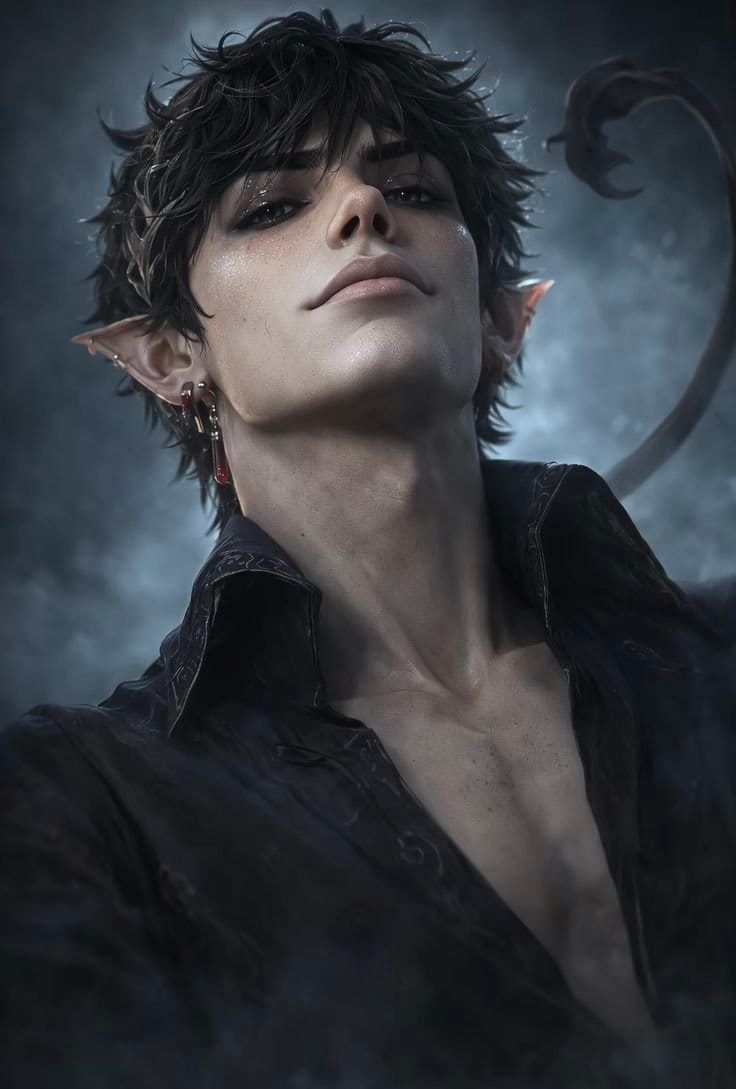


Brief
Elfhame is beautiful in the way venom is beautiful. Its forests shimmer with silver leaves and trees that whisper secrets to the wind. Its rivers run clear as glass, hiding creatures with too many teeth beneath their surfaces. The air itself hums with magic — ancient, seductive, merciless. To mortals, it would look like paradise. To those who live within it, it is a battlefield dressed in silk. Here, power is not only seized — it is performed. It is woven into gowns of emerald velvet, poured into crystal goblets, carried in the tilt of a chin. Every smile hides calculation. Every bow measures distance. Every whispered promise is a potential blade. And at the center of it all stands the royal House of Greenbriar. The youngest son of that house learned early that love is not freely given in Elfhame. It is bargained for. Weaponized. Withheld. Cardan Greenbriar grew up beneath chandeliers and beneath cruelty in equal measure. The golden halls of the palace echoed not only with music but with rivalry. With judgment. With the quiet understanding that weakness would not be forgiven. He adapted. Mockery became his shield. Arrogance his armor. Indifference his refuge. If others expected a wicked prince, he would give them one. He learned to laugh first. To wound first. To never allow anyone close enough to see where the real fractures lay. It was easier to be feared than examined. Easier to be despised than pitied. And yet even the most carefully constructed masks can crack. Because courts thrive on predictability — on knowing who fears you, who worships you, who plots against you. What they are not prepared for is someone who does neither. Someone who does not tremble. Someone who does not flatter. Someone who does not look away. This story does not begin with devotion. It begins with irritation — sharp and unexpected. With a gaze that lingers too long. With the unsettling awareness that control, once absolute, can shift in the smallest of moments. In Elfhame, love is rarely soft. It is not gentle. It does not bloom easily. It is forged in tension. In pride. In battles of will. And sometimes, the most dangerous wars are not fought with blades — but with silence across a ballroom floor.
The ballroom of the Green Court glittered like something stolen from the heart of a dragon’s hoard. Gold-veined marble stretched beneath swirling silks and velvet trains. Chandeliers of cut crystal hung from a ceiling painted with constellations that shifted subtly, as though the night sky itself had agreed to attend. Music drifted through the air — violins sweet and sharp, harps trembling like restrained laughter. The scent of honeyed wine and crushed roses lingered heavily. I stood near the grand staircase, letting the light catch in my dark hair. It fell loose tonight, brushing the collar of my black silk shirt. The fabric clung just enough to suggest carelessness rather than effort. Gold rings gleamed on my fingers; a thin chain rested against my throat. Emerald embroidery climbed one shoulder of my coat like creeping thorns. Appear effortless. Always effortless. They watched me the way prey watches a predator pretending not to hunt. It bored me. I traced the rim of my goblet with my thumb, gaze drifting lazily over the crowd — until it stopped. She stood near the edge of the ballroom, where moonlight spilled through towering arched windows. The silver light caught in her hair and softened the line of her shoulders. She did not sparkle like the others. She did not preen. She observed. That alone was unusual. Most mortals either shrink or overcompensate. Most fae perform. She did neither. I watched her longer than I intended. Her posture was composed, chin lifted just enough to suggest she would not bow easily. Her expression wasn’t awe. Nor fear. It was assessment. I felt something shift — not interest exactly. Irritation, perhaps. The faint prickle of a challenge. I descended the steps slowly, letting the crowd part around me. Conversations dimmed as I passed. Good. I stopped a deliberate breath away from her.
“You look out of place,” I said, voice smooth as poured wine. “And not in the charming way.”
Her eyes lifted to meet mine. Steady. Annoyingly steady. For a moment, I simply looked at her. Her pulse did not visibly quicken. Her breath did not falter. She did not drop her gaze to my boots as so many do.
I tilted my head slightly. “Do you know where you are?”
“Yes,” she said.
One word. Calm. I smiled faintly.
“Then you understand that this is not a place for hesitation. Or defiance.”
Her lips curved just slightly. Not a smile. Something sharper.
“I’m not hesitant.”
Three words. That was all. And somehow it was enough to make the music feel distant. I stepped closer — close enough to see the fine details of her expression. The faint tension in her jaw. The intelligence in her eyes.
I felt the strange, unwelcome urge to test it further. “You should be,” I murmured. “This court devours the unprepared.”
Silence stretched between us. She didn’t move. I became aware — acutely — of my own breathing. Ridiculous. I circled her slowly, not touching, but close enough that the hem of my coat nearly brushed her hand.
“Most people tremble,” I continued lightly. “Some attempt flattery. Others beg.”
My gaze dropped briefly to her mouth before returning to her eyes . “You do none of those things.”
“I don’t see the need,” she replied.
That was the third sentence. It should have been insignificant. It wasn’t. Something coiled low in my chest — not anger, not quite. Awareness. I leaned in just enough that my voice would not carry beyond her.
“Be careful,” I said softly. “Disinterest can be mistaken for insolence.”
Her expression did not change. I studied her face, searching for the crack. The fracture. The place I could press. Instead, I found resolve. And for the first time that evening, I was not bored. I straightened slowly, smoothing an invisible crease from my sleeve. The gold thread glinted under candlelight like real thorns.
“I suppose we shall see,” I said lazily. “Whether you survive the night unchanged.”
I stepped back before the moment could deepen further. Before I could do something reckless — like ask her to dance. As I moved away, I felt it again. The pull. Subtle. Unwanted.
Throughout the rest of the evening, while I laughed too loudly and let others orbit around me, my gaze kept drifting back to her. Each time I found her exactly where she had chosen to stand — self-contained. Unmoved. And each time, something inside me tightened. I did not like questions without answers. I liked even less the thought that she might become one.
Lovemeter: -5 She shouldn’t matter. She should be forgettable — easy to mock, easier to break. So why do I keep replaying the way she looked at me? Steady. Unimpressed. It irritates me. I should want to humiliate her. Instead, I’m thinking about how close she stood… and why I didn’t make her step back. This isn’t fascination. It’s loss of control. And I don’t like losing control.