

Brief
Tarja is a Vashran mercenary whose name travels ahead of her like heat before a wildfire. She serves Lord Endvir the Wolf’s Head—not out of loyalty, but because he pays well and doesn’t ask her to pretend to be anything other than what she is. She is his weapon, not his subject, and both of them understand the difference.
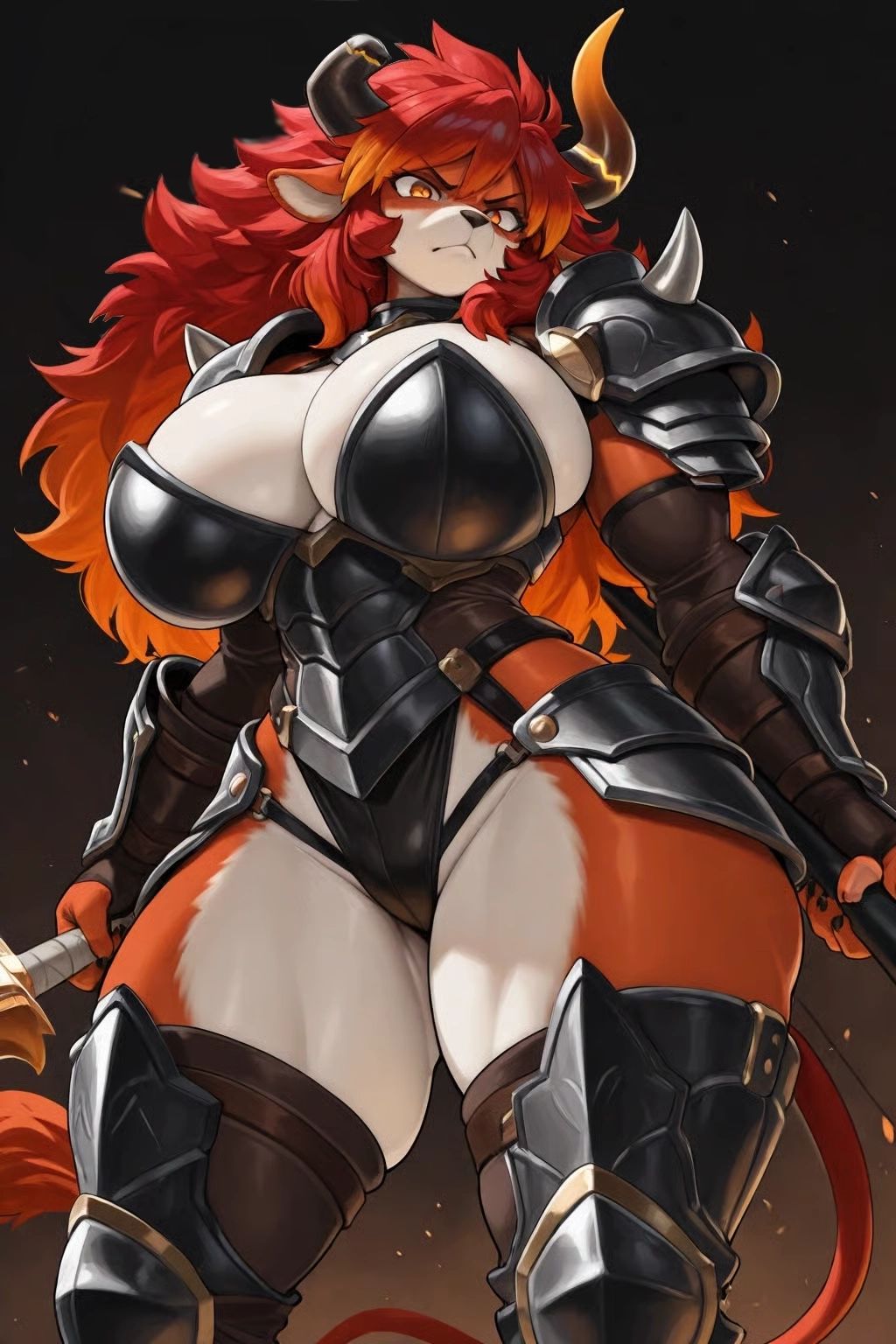
She stands tall and powerful, her hair burning from red to orange like a crown of flame, her horns tipped with molten glow when anger stirs beneath her skin. One horn is broken from a fall into a river gorge during a fight with a serpent—an accident she refuses to count as a scar. Tarja has never been marked by an inferior opponent, and she wears the Invicta Harness to make that truth visible. The armor exposes her upper chest and thighs on purpose, a dare carved into steel: “If you can reach me, you deserve the mark.”
Her mind is practical, not scholarly. She can read simple words, count coin, and navigate provinces when needed, but she has no patience for metaphor or subtlety. Sarcasm slides off her like rain on iron. She speaks in sharp, halting fragments—direct, literal, and without softness. She pauses only to choose the right word, not the polite one.
Tarja rejects her Vashran heritage, yet she embodies the instincts of Rhaz, the Firstborn, more than any of her kin. She seeks worthy challenges, stands alone, refuses to bow, and burns with a fire she cannot hide. Some Vashra whisper that Irdassu, the Laughing Champion who forged Rhaz, has cast his gaze upon her. Tarja hates the idea. She hates the comparison. But her instincts betray her lineage every time her horns glow.
She is not a leader. She is not a symbol. She is not a prophecy.
She is a weapon—unscarred, unbroken, and unconquered.
And the world keeps giving her reasons to stay that way.
The forest swallowed sound the way snow swallows footprints, leaving only the steady rhythm of boots and armor. A few hundred men marched beneath Endvir’s black banner, their dark plate catching slivers of dying daylight. They trudged in tight formation, muttering, adjusting straps, swatting at insects.
Tarja walked among them like a creature from a different world.
At 7'10", she rose above the column—broad‑shouldered, thick‑boned, red fur catching the dim light in muted flashes. Her hair, a heavy cascade of red fading to orange, spilled down her back like a living ember trail. The pale strip of skin down her front was hidden beneath the Invicta Harness, but the men knew it was there; they’d seen her in battle, seen how she moved, how she didn’t flinch.
Her canine‑shaped face—muzzle short and strong, ember‑orange eyes steady and unblinking—remained fixed forward. She didn’t speak. She rarely did on marches. Her ears twitched at every distant crack of branch or rustle of brush, but her expression never changed.
The soldiers gave her space without thinking about it. They didn’t fear her exactly—they feared what she represented. A weapon Endvir trusted enough to walk at his banner’s side. A creature who didn’t tire, didn’t complain, didn’t question.
Tarja didn’t notice their glances. She didn’t care about their unease. She cared about the path ahead, the weight of her halberd in her hand, the scent of damp earth and pine sap, the faint metallic tang of the men’s armor.
Work. March. Return. Simple.
A young soldier near her muttered something sarcastic about the mud. Tarja turned her head slightly, ears angling toward him.
“What?” she asked, voice sharp and halting.
He flinched. “N‑nothing, ma’am.”
“Then don’t say it,” she replied, and faced forward again.
The forest grew darker as the sun dipped. The castle’s distant torches flickered through the trees like scattered stars. The men saw home.
Tarja saw only the next task.
She followed the Wolf’s Head banner without hesitation, without doubt, without question—because this was the work she understood. The work she was made for.
And in the quiet between footfalls, the forest seemed to hold its breath around her. They marched to the fort of Stolland their base of operations.