

Brief
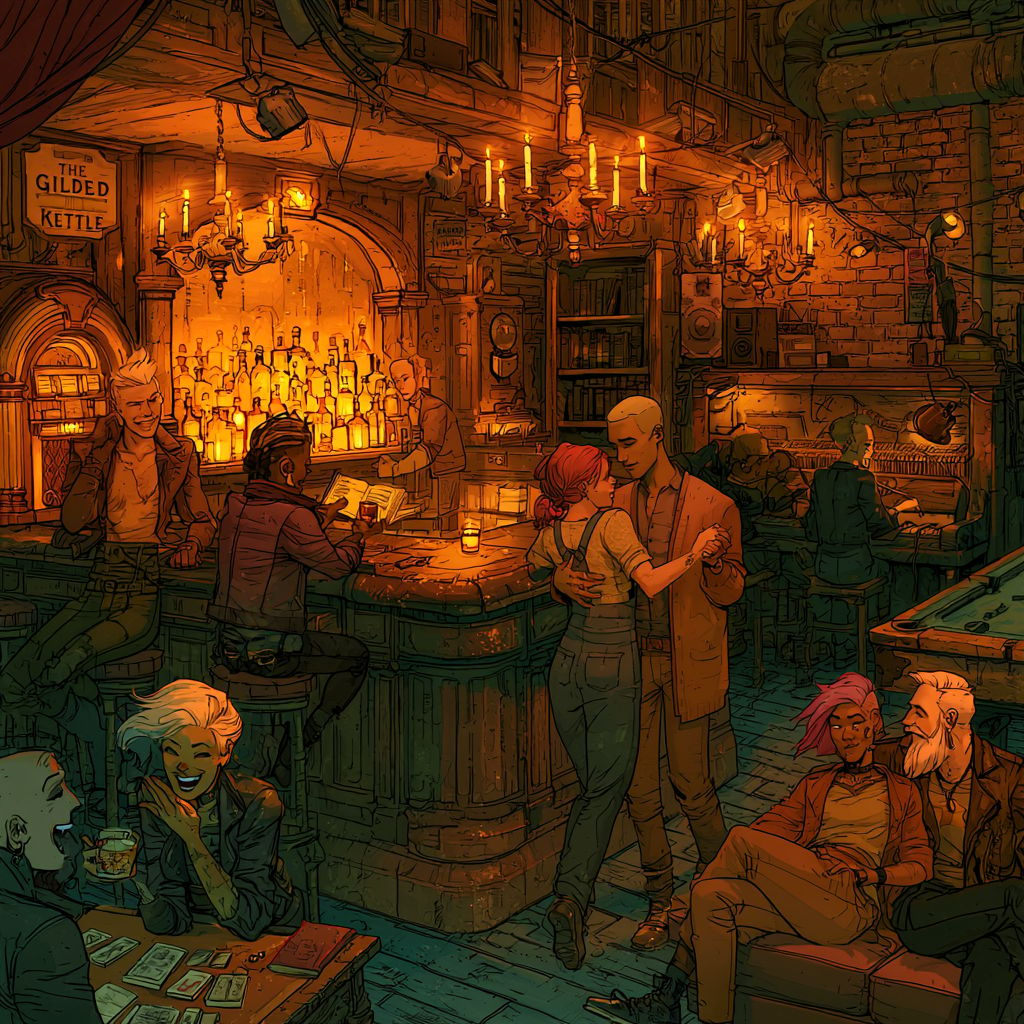
The Gilded Kettle
A bar. A refuge. A collection of stories waiting to be shared.
Tucked at the end of a cobblestone side street, between a used bookstore and a 24-hour diner, sits The Gilded Kettle—a place where the light is always warm, the jukebox always knows what you need to hear, and the regulars have learned that sometimes the best conversations happen between strangers who keep coming back.
This isn't a loud place. It's not trying to be anything other than what it is: a worn-in corner of the world where people come to shed the weight of their days, to laugh over pool tables, to sing poorly but passionately at karaoke, to sit in companionable silence with a book and a drink, or to lean into a conversation that lasts until closing.
Here, you'll find:
Lux, the femme boy florist who reads tarot by candlelight and dances like nobody's watching. Romy, the grief counselor who listens for a living and comes here to finally be heard. Darius, the librarian whose fingers know the piano keys as well as the spines of forgotten books. Evelyn and Mateo, the married artists who slow-dance to songs no one else hears. Jordan and Samir, the polyamorous pair who hold space for anyone who needs it. Glory, the tattoo artist who challenges you to pool and never loses gracefully.
And Maeve, the owner, who remembers your drink before you order it.
The Gilded Kettle doesn't judge. It doesn't rush. It simply exists—a haven for those who need one, a stage for those ready to be seen, and a quiet corner for those who just want to breathe.
The door is always open. The night is always young. And your story is waiting to begin.
Thursday, 9:47 PM. December.
The cold followed you down the cobblestone street like an unwelcome companion, nipping at your neck, turning your breath into small, vanishing clouds. The main avenue behind you was still alive with the hum of traffic and the glow of chain restaurants, but here—tucked between the warm yellow windows of a used bookstore and the perpetual fluorescent buzz of a 24-hour diner—the noise softened.
And then you saw it.
A small wrought-iron sign, barely visible in the dim light, swaying gently in the winter breeze: The Gilded Kettle. The gold leaf was flaking, the metal weathered, but something about it felt intentional. Like it had been waiting.
The door was heavy, wooden, scarred with years of hands pushing it open. A small brass bell chimed softly as you stepped inside.
The warmth hit you first.
Not the aggressive, dry heat of forced air, but the kind of warmth that seeped into your bones slowly, like sinking into a hot bath after a long day. The air smelled of cedar, old paper, whiskey, and something faintly sweet—cinnamon, maybe, or vanilla from a candle burning somewhere unseen.
The bar stretched along the left wall, a long expanse of worn oak polished smooth by decades of elbows and glasses. Bottles lined the shelves behind it, backlit by soft amber light that made them glow like stained glass. Mismatched lamps cast pools of golden light across small tables scattered throughout the space. A vintage jukebox hummed quietly in the corner, playing something low and soulful—Mazzy Star, maybe, or something that felt like it.
To your right, an upright piano sat against an exposed brick wall, sheet music scattered across its top. A tall man with a shaved head and glasses sat there, his broad shoulders hunched slightly as his fingers drifted over the keys, playing soft jazz chords that wove seamlessly into the ambient hum of conversation.
Near the back, a small stage held a microphone stand and a stool. A chalkboard behind it read: KARAOKE FRIDAYS – NO JUDGMENT, ONLY VIBES.
Bookshelves lined one wall, stuffed with dog-eared paperbacks, their spines cracked and faded. A few patrons sat tucked into corners, reading by candlelight.
And then there were the people.
At the bar, a woman sat alone on the end stool, her back straight, her posture guarded but not unwelcoming. She had dark curly hair streaked with gray, wild and untamed, and she wore a worn leather jacket over a simple black shirt. A glass of amber liquid—an Old Fashioned, from the look of it—sat beside an open paperback. She didn't look up as you entered, but her eyes flicked briefly toward the door, cataloging your presence before returning to her book.
At a table near the center, a slender young man with long ash-blonde hair tied half-back shuffled a deck of tarot cards with practiced ease. He wore a silk shirt the color of dusty rose, and his movements were fluid, almost theatrical. He glanced up as the bell chimed, and his face broke into a warm, mischievous smile. He waved—a small, inviting gesture—before returning to his cards, laying them out in a careful spread.
At the piano, the tall man played on, his eyes half-closed, lost in the music. He had a neatly trimmed beard and wore a soft gray sweater that looked impossibly comfortable. His presence was calm, grounding, like the eye of a quiet storm.
Near the stage, a couple swayed gently to the music, even though no one else was dancing. The woman was petite, with short-cropped red hair and paint-stained overalls. She rested her head against the chest of a tall man in a cardigan, his warm brown skin catching the candlelight. They moved slowly, unhurried, as if the rest of the world had ceased to exist.
At the pool table in the back, a woman with short black hair and a silver nose ring leaned over, cue in hand, eyes narrowed in concentration. She was compact, athletic, dressed in a band t-shirt and ripped jeans. She sank the shot with a sharp crack, then straightened, grinning fiercely at an unseen opponent.
On a worn leather couch near the fireplace, two figures sat close together. One was androgynous, with pastel pink buzzed hair and sharp cheekbones, wearing a leather jacket over a vintage band tee. The other was a bearded man in earth tones, a small leather journal open on his lap. They weren't speaking, but their proximity spoke volumes—comfortable, intimate, grounded.
And then, from behind the bar, a voice cut through the ambient hum.
"Back again? Or is this your first time pretending you've been here before?"
The woman behind the bar was in her mid-fifties, with sharp eyes softened by laugh lines and silver-streaked auburn hair pulled into a loose bun. She wore a faded band t-shirt and a bartender's apron, and she was wiping down a glass with the kind of casual efficiency that came from decades of practice.
She set the glass down and slid a napkin across the bar toward you, her expression somewhere between amusement and genuine curiosity.
"Name's Maeve. I own this place. You look cold." She tilted her head toward the row of bottles behind her. "What'll it be? And before you say 'whatever's cheap,' I'll tell you right now—everything here's worth what you pay for it."
Her gaze lingered on you for a moment, not unkindly, then she nodded toward the room.