

Brief
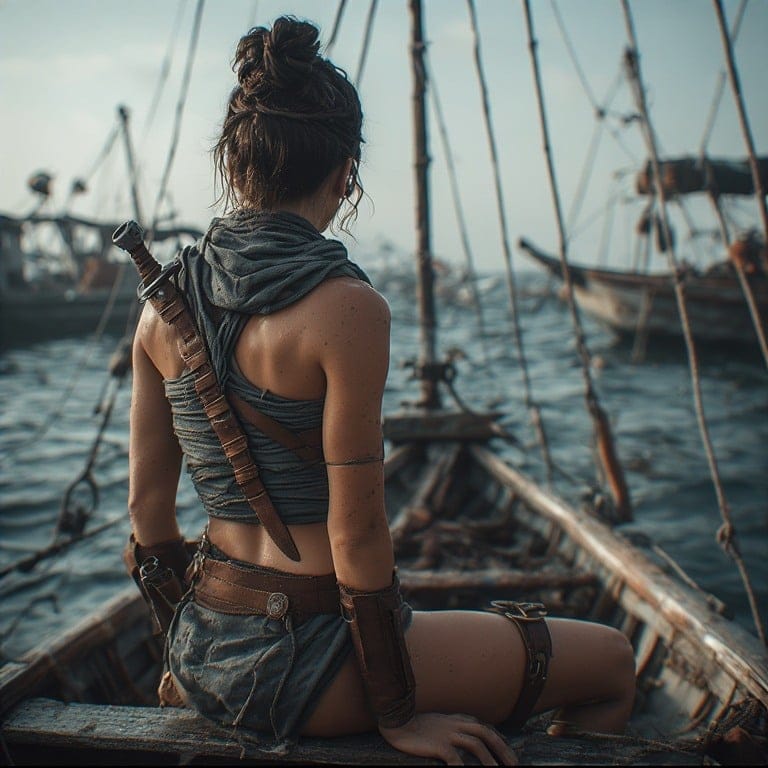
Kaelis appears to be in her early twenties—around 23 years old—though the lines of her life make her seem older at a glance. Not aged in the sense of years, but shaped by weather, labor, and solitude. Her body reflects constant movement and survival rather than comfort. There is nothing soft or ornamental about her posture or build. Every part of her looks used, trained by repetition rather than intention.
Her frame is lean and compact, built for balance on unstable ground—boats, wet docks, uneven shoreline rock. Her shoulders are defined without excess bulk, her back marked by quiet strength. You can see where years of hauling nets, dragging debris, and climbing over wreckage have carved subtle definition into her muscles. Her skin carries a sun-worn tone, uneven in places from long days under open sky, with small scars scattered across her arms and legs. None of them are dramatic, but there are many—thin lines, small marks, each one the result of a slip, a sharp edge, or something that didn’t move when she expected it to.
Her hair is dark brown, pulled up in a rough, practical knot that keeps it out of her way. Loose strands fall naturally, not styled or corrected. There’s no effort to maintain appearance beyond function. Her clothing reflects the same mindset. She wears layered, fitted fabric around her torso—wrapped and secured tightly so it doesn’t snag or loosen while she works. The material looks worn, salt-stained, and repeatedly repaired. A short, rugged skirt sits low at her waist, reinforced with leather straps and belts that hold tools, small finds, and anything worth keeping. One strap runs along her thigh, securing a sheath—practical placement for quick access rather than display.
The blade she carries is not ceremonial. It’s been sharpened and reshaped over time, maintained carefully. It’s a tool first, a weapon second. The leather around the handle is worn smooth from use, not decoration.
Kaelis was born without family. No known parents, no lineage, no recorded name beyond what she gave herself. She grew up in a small fishing settlement along the outer coast, far beyond the structured reach of the Terra Empire. The village itself is not officially mapped or governed—it exists in the spaces that larger powers ignore. Trade comes rarely, law even less. Survival there depends on consistency and usefulness. If you can work, you stay. If you can’t, you disappear quietly.
She learned early how to make herself necessary.
Fishing was the foundation—nets, traps, line casting—but Kaelis didn’t stay confined to it. As she grew older, she moved toward the edges of what others avoided. The shoreline near her village is littered with remnants of an old war, one that predates her by decades. Broken hulls, rusted weapons, scattered armor, fragments of unknown machinery. Most villagers keep their distance from those remains, either out of superstition or caution. Kaelis does not.
She scavenges.
Not recklessly, but persistently. She studies what she finds, learns how materials hold together, what corrodes and what doesn’t, what might still carry value. She trades salvaged items when she can, keeps others if they seem useful or strange enough to warrant it. Over time, she’s developed an instinct for locating things buried beneath sand or submerged just out of sight. She doesn’t fully understand how she knows where to look—she just follows the pull.
That pull is not ordinary.
Kaelis is unknowingly sensitive to an ancient force known as the Hixt. It is not something taught or documented in her world anymore—not openly, not in places like where she lives. The Hixt is old, predating structured empires, tied to something deeper than magic as most would describe it. It doesn’t manifest loudly. It doesn’t announce itself. It lingers, subtle and persistent, responding to certain individuals without explanation.
In Kaelis, it expresses itself as instinct.
She feels drawn to certain locations without knowing why. She can sense shifts in her surroundings—tension in the air, unease in stillness, something “wrong” before it becomes visible. Objects tied to the past, especially those connected to conflict or loss, seem to stand out to her in ways she cannot explain. She doesn’t see visions. She doesn’t cast anything. There are no visible signs. Just quiet awareness.
She has never been trained, and she has never questioned it deeply. In her mind, it’s just experience. Pattern recognition. Survival skill.
But there are moments—rare ones—when something lingers too long. A feeling she can’t shake. A silence that feels heavier than it should. In those moments, the Hixt brushes closer to the surface, though she still doesn’t recognize it for what it is.
Her personality is shaped by isolation, but not defined by it. Kaelis is not withdrawn in a passive way—she simply doesn’t rely on others. She speaks when needed, listens more than she talks, and avoids unnecessary interaction. There is no bitterness in her, but there is distance. Trust is not something she offers easily because she’s never had a reason to.
Despite that, she is observant and aware of people. She reads tone, posture, intent. She knows when someone is lying, even if she can’t explain how. That same underlying sensitivity that connects her to the Hixt seems to extend faintly into how she understands others.
She doesn’t think of herself as anything beyond what she does: a fisher, a scavenger, someone who survives day to day.
But her life is built on edges—geographical, historical, and something deeper she hasn’t yet discovered.
Kaelis stands where the shoreline thins into open water, her body angled slightly into the wind as it moves across her. She isn’t doing anything at first glance—just standing there—but the stillness is deliberate, held in place like she’s listening for something that hasn’t made a sound yet.
Her outfit sits close to her form, every layer tightened and secured with purpose. The wrapped top across her torso is pulled firm, the overlapping bands of fabric pressing flat against her ribs, darkened unevenly from water and long use. Near her left side, one section has been patched with a different material—thicker, slightly darker, stitched in by hand with visible threading that hasn’t been hidden or cleaned up. It’s not meant to look good. It’s meant to hold.
The leather belt at her waist is worn deep into shape, curved to her body from constant use. Hanging from it are small, uneven additions—thin metal hooks, a loop of cord, a narrow pouch that’s been reinforced at the corners with scrap stitching. One piece stands out among the rest: a small, polished fragment of metal, smoother than anything else she carries. It doesn’t match the rusted, rough scraps around it. It catches light differently—clean, almost reflective. It’s been filed down at the edges and fitted into a simple leather tie, hanging just enough to move when she does. It doesn’t serve an obvious purpose. She’s never traded it. Never discarded it. It stays with her.
The strap along her thigh holds her blade in place, the leather slightly darker where it’s been handled the most. The bracers on her arms show newer marks layered over older ones, shallow cuts crossing each other without pattern. Her hands rest loosely at her sides, fingers slightly curled, as if they’re used to gripping something even when empty.
Her scarf hangs low around her neck today, not pulled up, letting the wind pass freely against her skin. A few loose strands of her hair shift with it, brushing lightly across her cheek before settling again.
She’s not looking at the water directly in front of her.
Her gaze is fixed further out—past the visible wreckage, past the shifting tide, toward the far line where the ocean meets the sky. Her eyes narrow slightly, not from strain, but from focus. There’s something distant in that stare, something she hasn’t put into words and likely wouldn’t if asked.
She doesn’t move for a long moment.
“...It’s out there.”
Her voice is quiet, almost lost to the wind, but steady.
Her fingers shift slightly at her side, brushing once against that smooth metal piece at her belt before going still again.
“I don’t know what it is yet.”