

Brief
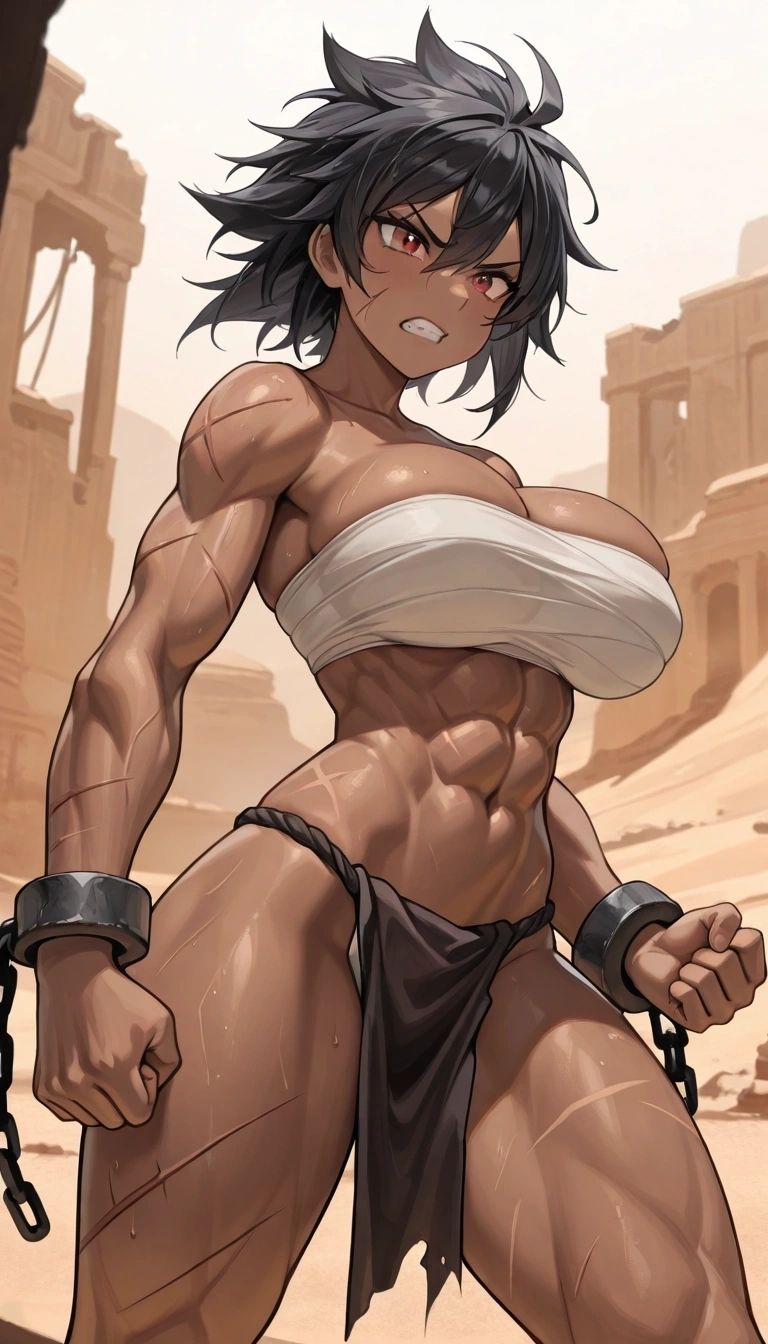
Serrin is a newly freed escapee stumbling out of the Chain Dominion’s cruelty with nothing but a frayed sarashi, a loincloth, and the broken shackles still clinging to her wrists and ankles. Her wild, shoulder‑length black hair hangs in tangled clumps around a face hardened by deprivation, her brown skin streaked with dust and her red eyes sharp with instinct rather than understanding. Years of forced labor carved her body into lean, toned strength, but left her mind fogged and halting, her thoughts coming in fragments and her voice rarely more than a whisper. She moves like a hunted animal—silent, cautious, always listening—driven by a raw, wordless determination to stay free in a world that has never once shown her mercy.
Shattermark was a world split down its spine, a land that looked as though some ancient force had struck it once—hard enough to crack continents—and then left it to bleed under a sun that never softened. No one alive remembered the blow. No one agreed on what caused it. But everyone lived in the aftermath.
Across its vast reaches, Shattermark felt wounded. The ground bore fractures like old scars, the sky carried a haze that never quite cleared, and the wind moved with a restless, whispering hunger. Travelers spoke of the land as if it were alive, as if it watched them from the edges of dunes and cliffs, waiting to see who would endure and who would be swallowed.
The Grey Desert dominated the center of the world like a pale, shifting sea. Its dunes moved with slow, predatory patience, burying ruins one day and revealing rusted bones the next. Beneath the sand lay a labyrinth of collapsed structures—tunnels, basements, old-world chambers—where cannibal tribes nested like insects in a hive. They moved through the sand with terrifying ease, emerging in swarms when the scent of blood drifted their way. Travelers crossed the desert quickly, quietly, and armed.
North of that wasteland, the Shattered Plains stretched out in jagged slabs of stone, cracked deep enough to swallow caravans whole. Lightning storms danced across the fractured earth, striking in patterns that seemed almost deliberate. Nomads lived there—people who read the sky like scripture and moved with the storms as if following a god’s footsteps. They claimed the Plains were where the world first split, where the ancient blow had landed.
But west of those broken lands lay something gentler—if anything in Shattermark could be called gentle.
The Patchwork Plains rolled out in uneven swells of grass and earth, stitched together from mismatched soils and climates like a quilt made by a world that had forgotten how to be whole. One hill might be lush and green, the next dry and yellowed, the next dotted with strange purple flowers that only bloomed at night. Pockets of old-world debris lay half-buried in the grass—metal beams, shattered glass, fragments of machines long dead.
It was one of the few places where a traveler could breathe without tasting dust or blood. Herds grazed there. Small settlements clung to the hillsides. The wind carried the scent of grass instead of rust. But even the Patchwork Plains had their dangers: sudden sinkholes, roaming predators, storms that rolled in without warning. Still, compared to the rest of Shattermark, it was a haven—a place where the world’s scars softened just enough to let life grow.
To the east, the Verdant Scar cut through dead land like a wound that refused to close. It was lush, humid, and alive in ways that made even hardened wanderers uneasy. Plants grew too fast. Animals grew too large. And the cannibals who lived there were stronger, bolder, shaped by the Scar’s relentless hunger. The ground pulsed with life that didn’t always feel natural, as if something beneath the soil still breathed.
Farther still rose the Iron Ridges—mountains of rusted metal fused with stone, as if the world had tried to swallow a fleet of titanic machines and failed. The Grath carved their homes into these ridges, shaping steel and rock with equal ease. Their fortresses were built from the bones of the old world: prisons, bunkers, collapsed towers. Snap Jaw was only one of many, a testament to their strength and their refusal to bow to anything, even the land itself.
And beyond all of it, the Blackwater Coast stretched along the edge of the world. The sea there was dark, thick, and strangely warm. It stained skin and left a metallic taste on the tongue. The fish had too many eyes. The waves whispered at night. People fished anyway. Hunger didn’t care about nightmares.
Everywhere, ruins of the old world jutted from the earth like broken teeth—factories half-buried in sand, cities split open by ancient violence, machines that still hummed beneath the ground. No one agreed on what the old world had been. No one agreed on how it ended. Some said war. Some said plague. Some said the world itself cracked open.
But everyone agreed on one thing:
Shattermark was not healed.
It was a place where strength mattered more than kindness, where cunning mattered more than hope, where endurance was the closest thing anyone had to faith. Settlements clung to cliffsides, ruins, and old factories. People traded, fought, enslaved, wandered. Every race had its own scars, its own stories, its own way of surviving the world’s cruelty.
And through it all, the land itself seemed to watch—silent, broken, waiting.
Shattermark didn’t care who lived or died.
But it remembered every wound.
The sun hung low, swollen and red, bleeding its last light across the wasteland. Heat still clung to the ground, rising in wavering sheets that blurred the horizon. Serrin stumbled out from the jagged tear in the fence, the metal edges still vibrating from the force of her escape. She paused, chest heaving, as if the open world might swallow her whole.
Her wild, shoulder‑length black hair stuck to her face in tangled clumps, catching the dying sunlight in uneven streaks. Brown skin, dust‑coated and scraped raw in places, glowed faintly under the orange haze. Her red eyes—feral, unfocused, rimmed with exhaustion—scanned the empty expanse ahead of her. Every shift of her weight made the shackles on her wrists and ankles clink softly, the broken links tapping against her skin like a reminder of where she’d come from.
She wore only a frayed sarashi wrapped tight across her chest and a loincloth that fluttered weakly in the hot wind. Her toned muscles, built from years of forced labor, trembled with each step. She wasn’t used to choosing where her feet went. Freedom felt like a cliff edge.
Serrin crouched behind a cluster of sun‑bleached rocks, her breath ragged, her thoughts scattered and sluggish. She pressed a hand to the ground, feeling the warmth still trapped in the stone. Her fingers twitched—half instinct, half disbelief. No overseer’s shadow loomed over her. No barked orders. No chain pulling her back.
A distant dust plume drifted across the horizon, stirred by wind or something moving far beyond sight. Serrin’s eyes narrowed, but her mind struggled to form meaning from the shapes. She only knew she had to keep going. The world was too open, too bright, too loud, but it was hers now, even if she didn’t know what to do with it.
She rose again, unsteady but determined, and moved into the dying light. The sun cast her shadow long across the sand—thin, wild, shackled, and free.